Blog
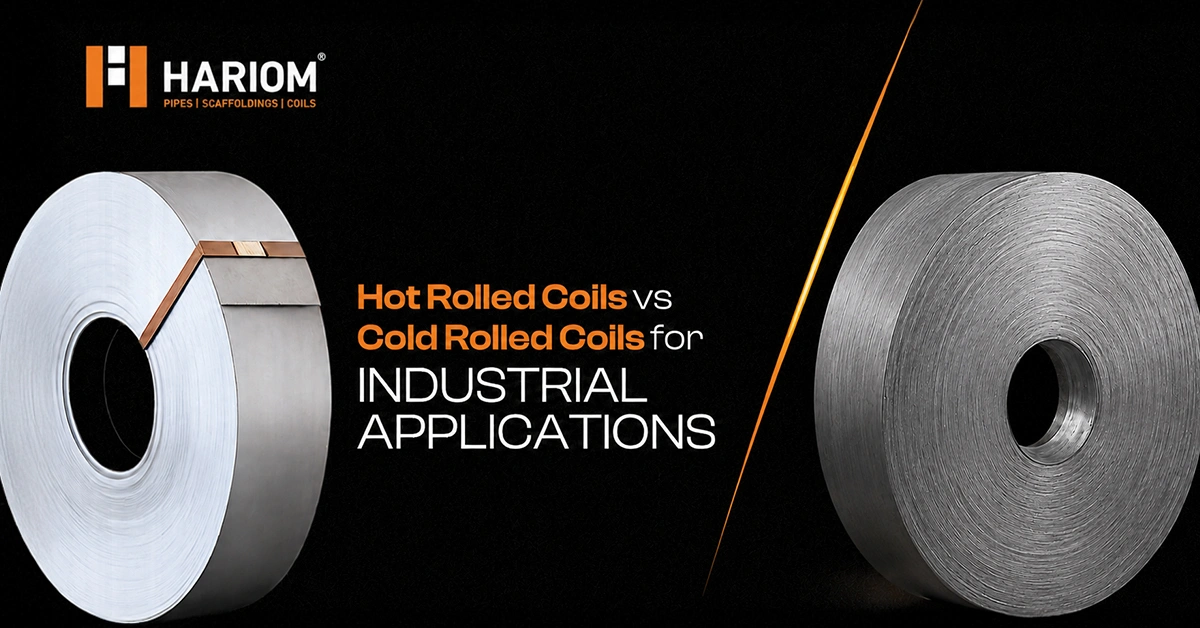
Hot Rolled Coils vs Cold Rolled Coils for Industrial Applications
Smart Infrastructure Smart Infrastructure
Choosing the right steel material is essential for ensuring the performance, durability, and cost efficiency of industrial projects.
Among the most widely used products are hot-rolled steel coils and
cold-rolled steel coils. Although both are produced from the same base
material, their manufacturing processes give them distinct properties suited to different applications.
From construction and engineering to automotive and fabrication, understanding these differences helps businesses make informed decisions.
Products such as mild steel coils, HRPO Slit Coils, GP Slit Coils , and CRCA Slit Coils further expand the options available for specific
industrial requirements.
Understanding Hot Rolled Steel Coils
Hot-rolled steel coils are manufactured by rolling steel at temperatures above its recrystallisation point. This process makes the steel easier to shape into different thicknesses and sizes while maintaining excellent strength.
As the coils cool naturally, they may have a rougher surface finish and slight dimensional variations. However, these characteristics have little impact on applications where appearance is not critical.
Key Benefits
- Cost-effective production
- Excellent weldability and formability
- High strength for structural applications
- Available in various thicknesses
- Suitable for heavy engineering and fabrication
Hot rolled coils are commonly used in construction, machinery, railway components, industrial equipment, and structural fabrication.
Mild steel coils produced through this process are particularly valued for their versatility and affordability.
What Are Cold Rolled Steel Coils?
Cold Rolled Steel Coils are processed further after hot rolling by passing the steel through rollers at room temperature. This additional step improves dimensional accuracy, strength, and surface finish.
The result is a smoother, more uniform product suitable for applications that demand precision and aesthetics.
Key Benefits
- Smooth surface finish
- Improved dimensional accuracy
- Higher tensile strength
- Better hardness
- Ideal for painting, coating, and precision fabrication
Cold rolled coils are widely used in automotive components, appliances, furniture, electrical equipment, and precision engineering.
Hot Rolled Coils vs Cold Rolled Coils: Key Differences
| Feature |
Hot Rolled Steel Coils |
Cold Rolled Steel Coils |
| Manufacturing |
Rolled at high temperature |
Processed at room temperature |
| Surface Finish |
Rough |
Smooth |
| Accuracy |
Standard tolerances |
Tight tolerances |
Choosing the Right Steel Coil for Your Industry
Selecting the right coil depends on your operational and environmental requirements.
Mild steel coils are widely used in fabrication, construction, storage systems, and industrial equipment because of their excellent machinability and weldability.
HRPO slit coils undergo pickling and oiling to remove mill scale and improve surface quality. They provide better weldability and are commonly used in automotive components, laser cutting, and engineering fabrication.
CRCA slit coils offer superior dimensional accuracy and surface finish, making them suitable for electrical panels, furniture, appliances, and precision-manufactured components.
GP slit coils are zinc-coated to improve corrosion resistance. They are ideal for roofing, HVAC systems, electrical enclosures, agricultural equipment, and industrial storage where long-term rust protection is required.
Hariom Pipes: Delivering Quality Steel Solutions
Hariom Pipes has established itself as a trusted manufacturer and supplier of quality steel products for diverse industrial applications. Its
portfolio includes hot-rolled steel coils, cold-rolled steel coils, mild steel coils, HRPO slit coils, GP slit coils, and CRCA slit coils,
serving the needs of the construction, automotive, engineering, and manufacturing industries.
With advanced manufacturing processes, stringent quality control, and a strong distribution network, Hariom Pipes delivers steel solutions that ensure consistency, durability, and reliable performance across projects of every scale.
Conclusion
Both hot-rolled and cold-rolled steel coils play important roles in industrial manufacturing. Hot-rolled coils provide strength and cost-effectiveness for structural applications, while cold-rolled coils offer superior precision and finish for products requiring tighter tolerances.
Similarly, mild steel coils, HRPO slit coils, CRCA slit coils, and GP slit coils address specialised industrial needs across fabrication, automotive, engineering, and corrosion-resistant applications.
By offering a comprehensive range of quality steel products, Hariom Pipes continues to support industries with reliable solutions that enhance productivity, efficiency, and long-term performance.
Hot-rolled steel coils are rolled at high temperatures for structural applications, while cold-rolled steel coils are processed further at room temperature for improved precision and surface finish.
They are widely used in construction, fabrication, industrial equipment, storage systems, and engineering applications due to their versatility and weldability.
HRPO slit coils have improved surface quality, better weldability, and fewer surface defects, making them suitable for fabrication and automotive applications.
CRCA slit coils are commonly used in electrical panels, furniture, appliances, automotive parts, and precision-fabricated components.
GP slit coils are best suited for applications requiring corrosion resistance, including roofing, HVAC systems, agricultural equipment, and outdoor industrial structures.